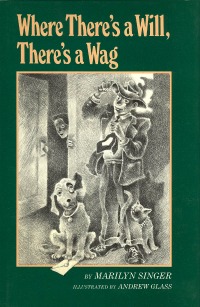
Where There’s a Will, There’s a Wag

Chapter One

It was all the talk at Rex King’s Bar.  Carlotta Bucks, president of the Purity Food Corporation, had finally kicked the bucket.  I’d like to be bighearted and say I was sorry about it, but the truth is, her company makes Peaceable Kingdom All-Vegetarian Pet Food.  The couple of times Barlowe fed that stuff to me I wished a fate worse than death to Carlotta Bucks.

Barlowe, by the way, is Philip Barlowe, famous detective.  And I, in case you haven’t figured it out, am Samantha Spayed, his all-too-loyal canine sidekick and the brains behind this duo.  Although you’d never know that if you read the newspaper accounts of our cases.  They always make it seem that Barlowe has done the work himself.  During our last case I’d resolved to let Barlowe do just that, but he almost got us in the soup, so I had to step in.  So much for letting him go solo.

To get back to Carlotta Bucks, crummy as the pet food is, her company raked in a lot of money over the twenty-two years she was its president.  But it was what Carlotta had done with that dough that the real excitement was all about. In her will, Carlotta Bucks had specified that she was leaving her money to none other than Snoogums, her “dearly beloved” cat.  There was talk that she had a nephew, a gambler, who’d contested the will, but without success.

“Twenty million smackolas to a cat,” said my pal and sometime employee Harry as we sat in our favorite dark corner of Rex King’s Bar.  As usual I was waiting for Barlowe.  “What do you make of it, Sam?”

I stared gloomily into the bowl of popcorn Barlowe had set down in front of me. “Not much,” I lied.  The truth is I was pretty depressed.  There I was, in a dingy bar with a bowl of stale popcorn, which might be the last meal I’d be having for a long time if the detective business didn’t pick up for me and Barlowe soon, while some overstuffed cat was sleeping on silk cushions and dining on smoked salmon.

“I’ll tell you what I think,” Harry said philosophically.  “I think the world is made up of the haves and the have-nots, and right now you and I are in the latter category.  Which stinks.  But our luck could change any minute, so I’m not gonna let it get me down.  And neither should you, Sam.”

I didn’t bother to tell him I was already down.  So down, in fact, that this time I didn’t even care whether or not I got the credit on Barlowe’s and my next case just so long as there was a next case.

“Come on, Sam.  Time to go,” called Barlowe, sliding off his bar stool across the room.

I got up slowly.  “Thanks for the pep talk, Harry,” I said.

“Yeah.  Well, keep me in mind if anything starts shaking.”

“Will do,” I answered.  But I couldn’t help thinking the only things that would soon be shaking would be Barlowe and me when our landlord booted us out in the cold for not paying the rent.

“Raise or call, Barlowe?” asked Fat Bernie.

“Sloof!” I barked, meaning “Call,” but I knew it wouldn’t do any good.  I’ve never understood why whenever we’re broke, Barlowe goes out of his way to make us even broker.  Or why one of his favorite ways to land us in the poorhouse is poker, a game he has neither the luck nor the smarts to play well.

“You’re bluffing, Bernie,” said Barlowe.  “I raise.”

I let out a pitiful whine, shut my eyes, and wished once again we’d gone home from Rex King’s instead of straight to Fat Bernie’s Poker Parlor, which wasn’t a parlor at all but the grimy office of a crumbling parking garage in a lousy part of town.

“Okay, Barlowe, I’ll see you,” said Fat Bernie, matching Barlowe’s chips.

“I fold,” said Pumper Pete, one of the regulars.  He threw down his cards.

“Me too,” skinny Gladys Mernicki, another regular chimed in.

The third regular, Silent George, just put his hand down without a word.

“Well, Barlowe, that leaves you and me for the showdown.  What have you got?” said Fat Bernie.

There was a pause, and then I heard Barlowe say, “Three kings.”

I opened my eyes.  I’d been to Fat Bernie’s often enough to know a decent hand when I heard one.  I looked longingly at the chips, which represented a month’s worth of lamb chops.

“Okay, Bernie.  Let’s see you beat that,” Barlowe said.

Fat Bernie didn’t crack a smile.  He lay down his cards, but kept his big palm over them.  “How about…three aces,” he said, removing his hand.

Barlowe and I both groaned as Fat Bernie raked in the chips.

“I think I better qu-” Barlowe had started to say when we heard footsteps.

I jumped up from the corner where I’d been sitting to do my dog bit as a thin guy in a fancy suit with a newspaper until his arm appeared in the doorway. “Gentlemen–and lady–is this game closed, or can anyone join in?”

There was silence while everyone gave him the once-over.  I trotted up to him for a sniff.

“Depends on who that anyone is,” Fat Bernie finally said.

The man grinned.  One of his teeth flashed brighter than the others, and I guessed it was solid gold.  He reached in his pocket and pulled out a wad of dough.

“Welcome, Anyone,” said Fat Bernie.

The man grinned again and brushed past me to take a seat at the table.  I didn’t mind.  I was finished checking him out, although I hadn’t learned much.  The guy wasn’t wearing any cologne or after-shave, and his own smell wasn’t particularly interesting.  But something made me want to keep my eye on him.  Something I call a Hunch.

“What’s your name?” Fat Bernie said.

The man laid the newspaper under his chair and flashed his tooth a third time. “You can call me…Hy Stakes,” he said.

“Okay, Hy.  Since you’re a newcomer here, we’ll let you choose any game you want–as long as it’s poker.”

“That’s a mighty friendly gesture,” Hy said. “All right, then, I choose Anaconda Seven-Card Stud.”

“Anaconda, huh?” said Fat Bernie, sounding none too pleased.

“Count me out,” said Gladys.  “I gotta get home and feed the old man.”

“Are you gentlemen still playing?” asked Stakes.

“I’m in,” said Pumper Pete.

Silent George nodded.

Say no, Barlowe, I thought.  Say no.

“Yes,” he answered.

I groaned again and sank back down into my corner.

This game was different than the other poker games they usually played.  There was a lot more movement and a lot more betting.  The players kept passing cards to their neighbors and tossing chips in the pot.  I could Hy Stakes was really enjoying himself.  He sat there relaxed, one hand holding his cards, the other resting under the table in his lap.

Barlowe, on the other hand, wasn’t enjoying himself at all.  In fact he looked like he does when he’s visiting the dentist.  I watched his small stack of chips get even smaller and contemplated getting up and going so I wouldn’t have to see my last chance at a square meal go down the drain.  Then all of a sudden I noticed a faint waxy smell.  I looked around to see if anyone else had noticed it, but they were all too busy passing their cards.  I took another sniff.  It was still there, and now I could tell where it was coming from:  Hy Stakes.  At first I couldn’t see anything.  Then as I watched, I saw him dip the fingers of his free hand into a little container resting in his lap.  Next he casually brought them up and touched them to the back of his cards.

Now, the finer points of poker may escape me, but there’s one thing I can recognize no matter what the game, and that’s a cheat.

I waited for the right moment.  Barlowe had just pushed the last of his chips into the pile in the center of the table.  Fat Bernie, giving a repeat performance, was asking what he had.

“Straight,” said Barlowe.  “You?”

Fat Bernie let out a sigh.  “Two pairs.”

They both turned to Hy Stakes.  He smiled again.  “Royal flush,” he said.  He reached for the chips just as I reached for him.  “What the–” he said, nearly falling out of his chair.

I growled, stuck my nose in his lap, and before he knew what was happening, grabbed the little container he held there.  Then I deposited it in Barlowe’s hand.

He held it up.  “What’s this, Sam?”

“Let me see that,” said Fat Bernie.  “Hey, that’s daub.  This guy’s been marking the cards!”

“Why you–” Barlowe stood up.

Hy Stakes backed away.  I let out a growl to tell him he wasn’t going very far.

“Get him, Barlowe!” yelled Pumper Pete.

Then a strange thing happened.  Stakes sat back down in his chair and started to laugh.  “So it’s true.  You’re as good as she said you were.”

I could tell Barlowe was confused.  To tell you the truth, so was I.  I sat down too.  Stakes reached out and shoved all the chips across the table toward Barlowe’s chair.  “Here’s the advance on your fee.”

“Hey, that’s my money,” said Fat Bernie.

Barlowe ignored him and said to Hy Stakes, “Huh?  My fee?  What are you talking about?”

I perked up, my Hunch buzzing like an alarm clock in my brain again.

“I’m hiring you, Mr. Barlowe,” Stakes said.

“Hiring me?  To do what?”

I knew the answer before Hy Stakes could flash his gold tooth again.  “To find my aunt’s real will,” he said.

I jumped to my feet, ready for action.  But Barlowe still hadn’t caught on.  “And just who is this aunt of yours?” he asked, not moving from his chair.

Stakes gave a little snort that suggested he was beginning to wonder if he’d made a mistake.  It didn’t seem that Barlowe would be able to find his way home, let alone a vanished will.  With a whine I grabbed the newspaper from under Stakes’ chair and nearly threw it in Barlowe’s lap.

He glanced down at it.  “What is this, Sam?  I already read the paper.  It’s all full of stuff about that Carlotta Bucks dame and her will…”  Then I saw his face change.  He looked up.  “Your aunt…”

“You got it, Mr. Barlowe,” said Hy Stakes.  “Carlotta Bucks, of course.”

Horsemaster

(excerpt from Chapter One)

The horse still dances on the horizon.

She holds out her hand.  “Come to me,” she says.  “Please come this time.”

There is a stillness, the kind that hangs in the air when a decision is about to be made.  The the horse tosses his head, and in a moment, he is there by her side.

She mounts easily, strokes his neck.  “I will go with you,” she says.

He whinnies once.  Then the hooves strike the hard ground.  The chestnut flanks shine, muscled and strong.  The mane whips lightly against her cheek.

“Faster,” she whispers, “Faster.”

The hooves clatter.  The trees, grass blur around them, a dizzy green.  A wind rises, whistling through her white gown.  It grows colder, but she doesn’t care.

“Faster,” she whispers again.  “Faster.”

The hooves make no sound.  The sky, so blue it surprises her, meets them.  The land is far below.  They rip through a cloud.  She closes her eyes.

“Jessica, I’m leaving now.”

Clouds all around, blocking the sun.

“Jessica.”

Losing speed.  The ground swelling steeply upward.  Falling.

“Jessica, I’m talking to you.”

She gasped, shuddered.  Then she opened her eyes.  “Am I hurt?” she asked.

“What are you talking about?  Of course you’re not hurt?” her mother snapped. “You must have been dreaming.”

“Yes, dreaming,” Jessica said, softly, and was immediately sorry.

“What were you dreaming about?”  It was not a question; it was a command.

“Something about a horse,” Jessica said reluctantly.

“A horse!  You’ve never been on a horse in your life.”

Jessica said nothing.  She was awake now and looking at her mother with sullen disdain.

“You don’t even ride a bike well,” he mother said, and laughed.

Jessica remained silent.

“When I was fourteen, I was the best bike rider in town,” her mother continued. But when Jessica failed to respond she stopped talking.

“Are you going to work now?” Jessica finally asked.

“Oh damn, now I’m going to be late,” her mother said, leaping to the door.  “You’re always making me late.”  As she hurried downstairs, she called, “Now you make sure you dress warmly today.  There’s a can of soup in the cupboard and bread in the bin.  And don’t you go out!”

“But I’m going back to school tomorrow,” Jessica said.

“Tomorrow’s tomorrow.  Today’s today.  And you will do as I say, young lady,” her mother yelled up.  “And if that Jack shows his face here, don’t you dare let him in, you hear?”

Then she slammed the door, and soon Jessica heard the car start up in the driveway.

She shut her eyes, trying to recapture the dream.  The horse.  It had finally come to her.  And she had ridden, no, flown on him.

She had dreamed of him so many times before.  The dreams were beautiful, although frustrating, because the horse had refused to approach her.  But this time he had come.  Why had he come?  And where had she been going with him? The questions suddenly frightened her as much as the dreams did.  For there were other dreams:  battles full of shadowy figures; men in patchwork robes walking in a processional; someone–something–shrouded in veils; blood. Sometimes the horse was there and she would cry to him for help.  She’d awake, tangled in the sheets and sweating, with the sick feeling she was dreaming someone else’s dreams.

Once, she had tried talking to Jack about the dreams, but it was difficult.

“Did you ever have…funny dreams?” she’d begun.

“Funny ha-ha or funny weird?” Jack asked.

“Funny weird.”

“Sure, lots of times.  Everybody does.”

She tried again.  “But did you ever feel as if they weren’t your dreams?  Sort of like you were looking into a mirror and seeing a reflection that looked a lot like you, but wasn’t you?”

Jack furrowed his brow.  “I don’t think so.  Do you?”

“Sometimes.”

“That is weird.  But then again, everybody has weird dreams.  I wouldn’t worry about them if I were you.”

Not even if you think the dreams are sort of calling you, as though there’s something you’re supposed to do, she had wanted to say, but she didn’t.  She couldn’t trust even Jack with that confidence.  She didn’t want him to think she was crazy and refuse to see her again.  Then she’d be all alone with her mother.

Suddenly, a handful of stones rattled against her window.  She jumped.  And then she giggled at herself and scrambled out of bed to the window.

It was Jack, just as she knew it would be.

She raised her left hand, opened and shut it three times, and then raced down the stairs in her nightgown and bare feet.

A Nose For Trouble

A Nose for Trouble

Chapter One

She was small, blonde, and very confused.  I could tell that before she opened her mouth.  But just how confused was a surprise even to me, and it takes a lot to surprise Samantha Spayed.

I should’ve known it was going to be one of those days even before the confused blonde showed up.  All afternoon I’d had an itch on my nose.  That itch always means trouble.

Besides my itchy nose, there was Barlowe working on those slogans again. Whenever we get broke enough, Barlowe starts entering contests.  He’s always hoping to win big bucks.  The only thing he’s won so far is thanks from the post office for shelling out so much dough on stamps.

A word about Barlowe, in case his name doesn’t ring a bell, which it should because he’s been in the papers a lot.  Philip Barlowe’s a detective.  They say he solved a lot of cases, including The Fido Frame-Up.  But if you were smart enough to read my account of the story, you’d know who really did the job. That’s right–yours truly.

After The Fido Frame-Up, I decided that I was going to sit back and let Barlowe try to solve our next case by himself.  I was tired of not getting any credit.  I promised myself I’d hang around as a bodyguard just in case things got sticky, but otherwise I’d take it easy.  The problem is I figured we’d be on another case right away.  I didn’t guess we’d both be taking it easy for so long.  For two long months nobody banged on our door except the landlord.  Nobody called us at odd hours.  And nobody’d given us any money.  Hence, Barlowe’s contest binge. What contest he was entering this time I didn’t know, and I didn’t want to know.

But Barlowe told me anyway.  “What do you think of this, Sam? ‘Elegant ladies used Eggelant (Egg-Rich) Shampoos.’  Nah.  How about this one:  ‘Eggelant (Egg-Rich) Shampoo is no yolk.’  Ha-ha.  Get it?

I wondered if Barlowe used the stuff himself and it had scrambled his brains.  I left him laughing to himself and went to the kitchen for some chow–lousy, cheap stuff, but better than nothing.  Just then, the buzzer rang.  I immediately went into my watchdog act.

“Who is it?” Barlowe asked through the intercom.

“Me.  Roper,” a voice answered

I stopped the watchdog number.  Barlowe didn’t need protection from Mandy Roper.  She’s a pal, a zookeeper and, in Barlowe’s own words, “one swell dame.” Roper hadn’t been around in a while.  She took a trip to Europe and sent us a couple of postcards.  She’d wanted Barlowe and me to go with her, but he’d turned her down.  He’d said we needed a rest, and that traipsing around Europe wouldn’t be one.  I wouldn’t have minded going alone with her, but nobody’d asked me.  Roper was hurt that Barlowe refused.  She didn’t say she was, but I could tell.  Noticing things like that is part of my job.

When Barlowe opened the door for Roper, I gave her the Big Greeting.  I jumped up and down, licked her hands and face, barked happily, the whole bit.  I only do the Big Greeting for a couple of people, and Roper, knowing that, had the good sense to be flattered.  “Whoa, whoa, Sam, old buddy.  It’s good to see you, too,” she said.

Barlowe was cooler than me.  “Hello, Mandy,” he said.

“Hello, Phil.”

“Have a good trip?”

“Very good.  How’s work been?”

“It hasn’t.”

There they were, two old friends acting like near strangers.  Then, Barlowe said, “I missed you, Mandy.”

“I missed you too, Phil.”

They hugged each other.  I gave them a small woof of encouragement.

They broke apart and Roper handed Barlowe a pile of envelopes and said gruffly, “Don’t you ever collect your mail?  The postman said he couldn’t fit any more stuff in your box.”

“Who needs a bunch of bills?” Barlowe said.

An envelope slid to the floor.  I gave it a sniff.  There was something familiar about the smell.  Familiar and delicious.  One thing I knew, it wasn’t a bill.  I picked it up with my teeth and nudged Barlowe’s leg.  My nose was itching like crazy, but I tried to ignore it.

Barlowe took the envelope.  “What’s this?  La Maison de Beauté?  Never heard of them.  I sure don’t owe them any money.”

I’d never heard of them either, but I liked that smell, so I nudged him harder. Roper took the envelope from him.  “La Maison de Beauté.  They make cosmetics. I use their bath oil.  It’s good stuff.  She opened the envelope, took out a single sheet of paper, and read:

“Dear Mr. Barlowe,

“Word of your talent and discretion in solving cases has reached me via a mutual acquaintance, Lady Binghampton-Nuggets.  I require your assistance in a matter both urgent and delicate.  Please come to my office at 500 Garson Boulevard on Tuesday, June 4 at 5:30 P.M.  If you cannot make it, then call me at 555-1357.

“Thank you.

Sincerely,

Roger de France, President”

Tuesday, June 4 at 5:30!  I let out a howl.  I could almost smell real meat again.

“What’s eating you, Sam?” Barlowe asked.

“Barlowe, do you know what day this is?” Roper asked.

“Yeah, Tuesday.”

“Which Tuesday?”

“June fourth.”

“Right.  And what time is it, Barlowe?”

He looked at his watch.  “Five-fifteen.”

“Five-sixteen to be exact,” Roper said, looking at her own.  “It takes twenty minutes to get to Garson Boulvevard.  If you leave right now you’ll be only six minutes late.”

I howled in agreement.  I’d said I’d stay out of Barlowe’s next case.  But there at least had to be a case for me to stay out of.

“Five-thirty.  I have another appointment at five-thirty.”

I knew about Barlowe’s “other appointment.”  It was at Rex King’s bar.  I picked up a hard rubber bone some relative of Barlowe’s bought me for Christmas, and which Barlowe used as a doorstop, and pitched it at him.  It hit his shin.

“Owww.  Take it easy, Sam.  Okay, okay.  I’ll postpone my other five-thirty appointment.  Let’s go.”

Thinking about porterhouse steak, I bounded out the door ahead of him.

On the drive to La Maison de Beauté, Barlowe kept working on his slogans. And I kept my head out the window so I didn’t have to hear him.  We were just approaching Garson Boulevard when he stopped the clunker of a Buick dead in the middle of the street (at least, I hoped he’d stopped it; the Clunker, as I called it, which we bought with the money from the last case, has been known to die by itself at the worst possible moments).  I fell back onto the seat.  “I’ve got it!” Barlowe yelled.  “Sam, you’ll love this one.  Here it is:  ‘A man’s best friend is his dog, but a woman’s best friend is her Eggelant (Egg-Rich) Shampoo.’  Isn’t that great…”

I didn’t hear the rest of what he said because just then the blonde staggered into view.  And coming at her from the other direction was a big, black sedan.

“Whoo!” I howled, meaning, Watch out!  I leaped out the open window and heard Barlowe yell, “Hey!”  The black sedan screeched to a halt, and the car behind it smashed into its fender.  I dashed up to the blonde.

“Come on.  Follow me,” I said.

“Come on!” I ordered.

She gave me a blank look, but she followed me, weaving in and out of traffic that had piled up on Garson Boulevard.

We reached the Clunker.  Barlowe opened the door.  “Sam, are you okay?”  You could’ve been hurt.”

I gave him a quick woof to let him know I was fine.  Then we both looked at the blonde.  She was hobbling a little, but there wasn’t a scratch on her.

Barlowe opened the back door.  The blonde stumbled onto the seat.

I scrambled up behind her.

“What’s your name?  Your address?” I asked.

She gave me that same blank stare.  Then she opened her mouth and said, “Yoghurt.”

I stared at her, and then it hit me.  The blonde was more than confused.  The blonde had amnesia.  No good-looking, self-respecting blonde cocker spaniel would let herself be called Yoghurt.

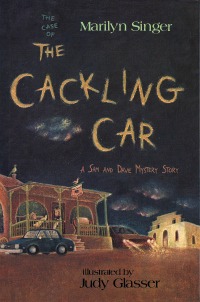
The Case of the Cackling Car

The Case of the Cackling Car

Chapter One

The kissing gourami were living up to their name.

“How long do you think they can go on like that?” Sam Bean asked his identical twin brother, Dave, as they both stared at the fish.

“For hours, I think,” Dave answered.  “Just like Mark Manganero and Susie Spitz.”

Sam laughed.  He and Dave had accidently stumbled across Mark and Susie sitting on a park bench with their lips locked together the day before.

“Hi, Davasam,” Ms. Chang, the owner of the pet shop they were in, called, using the name she’d made up for them.  “Solved any cases lately?”

“Not this week,” Dave said, with a smile.

“Well, even famous detectives need a break…Got some nice neon tetras in.”  She came over and pointed to an aquarium full of sparkling little fish.

“They are nice, but we’re leaving tomorrow on our Christmas vacation, just Sam and me,” Dave said, “and we can’t buy any new fish until we get back.  What we need today is some fish food.”

“Who’ll be taking care of your fish while you’re gone?”

“Our friend Rita O’Toole,” Sam said.  “Our parents are taking their own vacation in Florida.”

“Where are you going?” Ms. Change asked, getting them a container of food.

“To a small town in Texas named Papagayo,” Dave answered.  “It’s near the Mexican border.  Our aunt lives there, and she invited us for the big fiesta they’re going to have.”

“That sounds like fun.  Near Mexico, eh?  How about bringing me back a Mexican tarantula or two?”

“Gee, I don’t know,” Sam said, dubiously.

Ms. Chang laughed.  “I’m only kidding, Davasam.  There are very strict laws about bringing in animals from other countries.  You need papers, certificates, all sorts of things.  Sometimes, the animal has to be in quarantine for a long time.”

“Really?” asked Dave.

“Most definitely.  Unless you smuggle them in.  People try to avoid the cost and time by smuggling in animals.  But I don’t imagine you’d want a tarantula crawling around in your sneaker.”

“No, thanks.”

“Although it would most likely be the tarantula who suffered.  Anyway, here’s your fish food.”

Dave paid for it.

“Have a wonderful trip.  Tell me all about it when you get back,” Ms. Chang said, smiling.

“We will,” said Dave, and picking up his purchase, he and Sam left the store.

A Clue in Code

A CLUE IN CODE

Chapter One

The curve ball came at him in slow motion.  His bat, tugging at his arms, was poised, ready.  He swung, and the swing was clean and smooth.  Crack! Bat and ball connected.  The white sphere soared over the pitcher’s head, arced high above the outfield and landed smack in the hands of some lucky fan in the stands.  As he crossed home plate, he heard the crowd call his name, “Sam Bean! Sam Bean!”

“…did you, Sam Bean?”

Sam’s eyes focused slowly.  The fans, the stands, the field dissolved.  The cheers of the crowd turned to giggles.  it took him a moment to realize where he was and who was talking to him.  When he did, he turned red.  “Uh, I’m sorry, Ms. Corfein,” Sam said to his teacher.  “Could you repeat the question?”

The class giggled again.

“Asleep on the job, eh, Sam?” Ms. Corfein said.

“Way to go, Bean,” Willie Landers, sitting next to Sam, snickered.  Willie was a tough kid who always made snide remarks–especially to Sam and Dave, Sam’s identical twin brother.  Willie–and practically everybody else in the school–knew their reputation as private eyes, only unlike most other people, Willie disliked them for it.

“Sorry,” Sam mumbled again.  it wasn’t like him to daydream in school, but the November day was so gloomy, he’d got to thinking about April and baseball and the next thing he knew he’d dozed off.  He glanced over at his brother.  Dave wasn’t looking at him.  He was taking some money out of his picket, and he looked alert as always.

“I asked if you brought in your money for the class trip.  You and Roger Blitzman were the only ones who didn’t raise your hands,” said Ms. Corfein.

This time, Sam glanced at Roger.  He was a small, shy boy whom nobody knew very well.  He kept pretty much to himself.  Ms. Corfein was always calling on him to do jobs for her.  He might have been called “teacher’s pet,” except he didn’t act like one.

“Oh.  Oh yeah.  I brought it,” said Sam.

“Good.  Roger, would you please collect the money, put it in this envelope and put the envelope in my locker.  Here’s the key.”

Roger stumbled to his feet and began to walk around the room, collecting the money.  Sam turned to look at him just as he was putting the envelope in.  Then Roger locked the door and returned the key to Ms. Corfein.

“All right, class.  Turn to page forty-one of your workbook,” Ms. Corfein said.

The class groaned softly.

“Rita, tell us the answer to problem one.”  Ms. Corfein shivered slightly, went over to the long row of windows and began to fiddle with one of them.

Sam watched her for a moment, then opened his book.  The numbers began to swim in front of his eyes.  He had just hit his third homer when the lunch bell rang.  Three more hours to go.  I can tell nothing is going to happen today. Nothing at all, Sam thought.

In less than an hour, he’d find out just how wrong he was.

Archer Armadillo’s Secret Room

ARCHER ARMADILLO'S SECRET ROOM

(excerpt)

Archer Armadillo figured his burrow was the best burrow in the whole state of Texas.  It was warm.  It was snug.  And it had lots of rooms Archer could explore.

His grandfather–whom everyone, even Archer, called Old Paw–agreed with him.  After all, the burrow had been Old Paw’s before Archer and his mother and his father and his twelve brothers all moved into it.  Old Paw had lived there since he was small.

Sometimes, after Archer went exploring the burrow, he’d tell his grandfather what he found.  And Old Paw would laugh or look surprised or scratch his belly.

Once, in one of the rooms, Archer found an empty shell of armor just like his own, only bigger and harder and dustier.  When he told Old Paw, his grandfather slapped the ground and said, “Why, that must be my great-uncle Manus.  We always wondered what happened to him.”

The Case of the Sabotaged School Play

THE CASE OF THE SABOTAGED SCHOOL PLAY

Chapter One

“‘Sink me, if it’s not Jean La Fleet, the pirate king,'” Mary Ellen Moseby read in a bad British accent.

Dave Bean stifled a yawn.  Mary Ellen’s plays always put him to sleep.  He wouldn’t be in them–or in the Drama Club for that matter–if he didn’t like to act so much.  Acting was great.  Putting on a false nose, a wig, a tunic, a sword. Standing on stage in front of an audience.  Dave loved it.  He even thought he might become an actor when he grew up.  That is, if he didn’t become a private eye.

Mary Ellen switched to an equally awful French accent.  “‘The same.  And your weesh, Sir Hugo, is my command.  Gentlemen, sink zis sheep.'”

Joel Mazzara, president of the Drama Club, turned to Dave and whispered, not very quietly, “Baaaa.”

Mary Ellen’s already pink skin turned pinker.  Her upturned nose pointed to the ceiling as she said, in a snooty voice, “The trouble with you, Joel Mazzara, is that you have no taste.”

Joe stood up, hands on his hips.  “Well, then, there must be a lot of other people who don’t either, because nobody ever comes to your plays except the parents of the kids who are in them.”  He sighed and changed his tone.  “Look, Mary Ellen, you can write all right, but people don’t want to see stuff like this.  It’s corny.”  He turned to the rest of the club.  “What I think we should do is tell Ms. Kirby we want to put on a famous musical.  Something that everyone will like. Something like Grease.”

Grease!  The kids in the club began to murmur excitedly.  “I wanna be Danny.” “You’d be great as Sandy.”  “How about Donna as Rizzo?”  “My brother has this T-shirt I could wear.”

Dave was excited too.  “I could slick my hair back and wear a leather jacket and Mom couldn’t even complain,” he said to Sam.

Sam grinned and nodded.  He was shyer than Dave and went in more for sports than acting.  But he was thinking that if they put on Grease even he might ask Ms. Kirby, the director, if he could be in it, instead of working the lights as usual. It would be fun to jump around on a hot rod and act tough.

Then, a thin blond girl named Ginger Janowitz piped up.  “Ms. Kirby won’t let us put on Grease. You all know she thinks we should perform plays that students have written instead.  Besides, I like Mary Ellen’s play.  I think it’s…original.”

“Well, I don’t,” Donna Jordan put in.  “I think Joel’s right.  The Merry Pirates is–”

“A very fine play,” a grown-up voice said.

All heads turned to the doorway.  Standing there was Ms. Kirby, the drama teacher and director of the play.  “Now, I know some of you have been disappointed about the size of the audiences for our last productions, but I’m sure with a little more publicity, we’ll get a full–well, a fuller–house this time.  Mary Ellen’s put a lot of work into this play and we are going to put it on.”

“Not if I can help it,” Dave heard Joel mutter.

Other people sighed and shifted uncomfortably in their seats.

“I’ve chosen the cast,” Ms. Kirby went on.  “Joel, you will play Jean La Fleet. Dave, you’ll be Sir Hugo.  Donna will play Brigitte De Tour and Mary Ellen will be Brigitte’s maid, Fifi.  Jim, Sharon, Andy, Steve, Ron, Mike and Lois will be the pirates and Sir Hugo’s crew.”

“But Ms Kirby, you didn’t mention me,” Ginger Janowitz called out.

“I’m sorry, Ginger.  There aren’t any other roles. But you–and everyone else who didn’t get a part–can work on sets, costumes or the props.  We all have to pitch in to make this the best production we’ve ever had.  Here are your scripts.  See you tomorrow for the first rehearsal.”

Ginger got up to leave, and as she passed Donna, she gave her a nasty look.  Joel did the same to Mary Ellen, who had stopped smiling and appeared lost in thought.

Dave turned to Sam.  “Whew, I have a feeling this play isn’t going to go so smoothly.”  Sam nodded.  But neither one of them knew just how much trouble there was going to be.

Leroy Is Missing

Chapter One

“Even a famous detective like Sam Bean can mess up, “Dave Bean gasped.  He was running hard to keep up with his twin brother.  It wasn’t easy.  Sam was athletic, while Dave was not.  “Mom’ll get over it–even though you totally ruined her beaded sweater by throwing it in the washing machine.”

“It was stained,” Sam mumbled, and ran harder.  How come Dave never does anything wrong, he wondered.

“Hey, come on.  You know I can’t run that fast!”

“For a famous detective you’re awfully out of shape!” Sam called over his shoulder.

“Hey, look out!” Dave cried.

Too late.  Sam turned his head just in time to see the front wheel of the dirt bike crash into his leg, sending him and the rider into a heap on the road.

“Sam, are you okay?” Dave shouted.

“Owww!  You creep!  You made me fall!” hollered the rider, a red-haired, freckled kid of about eight.

Sam limped to his feet.  “I’m all right,” he called back to Dave.  He wasn’t really. His knees and elbows were bruised and he had a cut on his hand.

But the kid was younger and smaller than he, so he hobbled over to him and asked, “Where are you hurt?”

The kid pointed to his bike.  “Look at this!  You scratched the finish!  I’ll sue you!”

Sam stared at the bike and then at the boy.  There wasn’t a scratch on him. For one second, Sam wanted to haul off and deck him, but Dave, who’d caught up with them, said, “Listen, kid.  If anyone’s gonna sue, it’s us.  This accident was your fault.  You’re not supposed to ride along this path.  It’s for pedestrians.”

The kid looked from Sam to Dave and then back to Sam and shook his head as if to clear it.  “Hey, I”m seeing double.  Concussion!  I’ve got a concussion!”

“You’re going to have one if you don’t get out of here,” Sam muttered.

“What’s your name, kid?” Dave said, pulling a pad out of his hip pocket.  “In case we do sue.”

The kid gave them a tough look.  “Leroy.  Spelled L-E-R-O-Y.  And I don’t care if you do sue, ’cause I’m gonna tell my dad and he’s going to beat you up.”  Then he got on his bike and rode away.

“Man,” said Sam.  “I hope I don’t see him around in a big hurry.”

“Yeah,” agreed Dave.  “But doesn’t he remind you of someone?”

“Who?”

“That red-haired-girl in our class, Rita O’Toole.”

Sam thought about it and gave a little smile.  There was a slight resemblance, but Rita O’Toole was the smartest kid in their class and she seemed nice, too, not like the obnoxious jerk who’d just crippled him.  He shook his head.  “Nah.  No way,” he said.  “No way!”

The Course of True Love Never Did Run Smooth

Fiction for Young Adults

(Excerpt from Chapter 2)

Nemi and I became friends in the third grade because he didn’t want to play Baby Bear.  It was near the end of the term and our teacher, Ms. Lowenthal, told us that for the annual class play we would be doing Goldilocks and the Three Bears and that the main parts would be:  Goldilocks, Mama Bear, Papa Bear, Baby Bear and the narrator.

“Who can tell us what a narrator is?” Ms. Lowenthal asked.  “Becky?”

“A narrator is someone who tells the story,”  I said hurriedly.  “But Ms. Lowenthal, if there are only five big parts, what is the rest of the class going to do?”  Note that I said “the rest of the class” and not “the rest of us,” automatically assuming I would be playing one of the lead roles.

“That’s a very good question, Becky,” Ms. Lowenthal said.  “The rest of the class will be in the band and the chorus.”

There isn’t any band or chorus in Goldilocks and the Three Bears, I wanted to tell her, but I didn’t.

Then Nemi piped up.  “When are the auditions?” he asked.

Now, up until that time, I’d barely noticed Nemi.  He was small–the smallest kid in the class, as a matter of fact–and dark and fairly quiet.  But when he asked his question, I–and the whole class–turned to look at him.   Auditions? What were auditions?  What was this smart-ass kid talking about?

Even Ms. Lowenthal looked stunned.  “Ah, well, Nemi, that too is a good question.  There…um…won’t be any…ah…auditions.  I will pick people for the parts.”

“Oh” was all Nemi said.

“Ms. Lowenthal, what are auditions?” Kathy Flaherty asked, blinking her big blue
eyes and flicking back her long blond curls.

“Well, Kathy, auditions are…well, why don’t we let Nemi explain what they are.”

“They’re when people try out for parts in a play and the best people get the best parts,” he answered.

“Who decides who’s best?” Jimmy Biaggi asked.

“The director.  Usually.  But sometimes other people.  Last year in my other school we put on Snow White and the Seven Dwarfs and we had auditions before the whole class.  Then the kids got to pick who would play the parts.”

“What did you play?” I asked.

“The Prince,” he answered with a straight face.

And everyone oohed and ahhed.

“Well, I think that’s a dumb way to do things,” Kathy said.  “Ms. Lowenthal, you’re the director, aren’t you?”

Ms. Lowenthal, by now totally speechless at this group of Equity-card-carrying actors she hadn’t known she’d been harboring all year in her classroom, merely nodded.

“Well, then you see,” said Kathy, “you already know who’s best for each part. Don’t you, Ms. Lowenthal?”

Ms. Lowenthal cleared her throat and said, “Well, yes, as a matter of fact, I do believe…I…yes…I think I do.”

There was a silence, and then Jimmy said, “So, tell us who gets the parts.”

Ms. Lowenthal looked at her watch, cleared her throat again and said, “After lunch.”

The class groaned and trooped off to the cafeteria.

I immediately grabbed a seat next to Nemi.  “How do you know so much about plays?” I said.

“From my mother.”

“She’s an actress?” I said, getting excited.

“No.  She used to be a dresser.”

I must’ve looked blank because Nemi said, “She used to help actors get into their costumes.”

“Aren’t they old enough to dress themselves?” I said.

Nemi laughed.  “Ha-ha.  That’s very funny.”

But I hadn’t meant it as a joke.  I thought maybe she dressed child actors or something.

Finally, Nemi explained that actors often have complicated costumes they have to get in and out of fast and need a dresser to help them.

“Oh,” I responded.  “Did she like it?”

“Yes.  She wants to go back to doing it when my sister is a little older.”

“What does your father do?” I asked.

“He’s a dentist.”

“Ugh,” I said, then clapped my hand over my mouth in embarrassment.

“That’s okay.  Everybody says that.”  Then he asked.  “What do your parents do?”

“My mother’s an Avon Lady,” I said.  “I get lots of free perfume and soap and nail polish and lipstick and things.”

“You wear that junk?”

“Just for play.”

“What about your father?”

I turned a little red.  I never really knew what my father did.  Something about figuring out whether or not things will work right in a business.  It took me until I was thirteen to learn he was a systems analyst.  It will take me another twenty years to understand what that means.  “He does stuff with numbers,” I said.

“You mean he’s an accountant?”

“Something like that,” I said.  Then I changed the subject.  “Nemi, what part do you want to play in the play?”

“The narrator,” he said.  “It’s the best part.”

“How do you know that?”

“It was the best part last year in Snow White.”

“Oh.”

“How about you?  What part do you want?”

I wanted to play Goldilocks, but somehow I was embarrased to admit it.  “Mama Bear,” I lied.

“Baloney,” Nemi said.  “You want to play Goldilocks.  But you won’t get it.”

“Why not?” I asked before I could stop myself.

“Because that teacher’s pet Kathy Flaherty will.”

“How do you know?”

“Wait and see.”

So then we trooped back to class and sat very straight and very eager in our seats.  There was an air of expectation in the room.  Ms. Lowenthal looked more composed than she had before lunch.”

“Well, I’ve made my selection,” she said.  “Grace, what does selection mean?”

Plump Gracie Shapiro said, “It means you’ve made your choice,” in a crisp, clear voice.

“Good.  For the part of Goldilocks, Kathy Flaherty.”

Nemi looked at me with a grin.  I turned my head away from him and looked at Kathy.  She had a big smirk on her face and was twisting one golden lock around her finger just the way she had twisted Ms. Lowenthal.

“For Papa Bear, Jimmy Biaggi.  Mama Bear, Grace Shapiro.  For Baby Bear, Nemi Barish.  And for the narrator, Becky Weiss.”  She looked up with a smile.

Some of the class were grumbling and some were relieved.  Jimmy was growling and clawing the air.  Grace was beaming–it was her first speaking part in a play. The year before, she’d had to be the rear end of a donkey in The Bremen Town Musicians. And then I looked at Nemi.  His face was kind of pale for him and his eyes looked funny, like he was about to cry and didn’t want to.

“May I be excused, Ms. Lowenthal?” he sort of choked out.

“Not right now, Nemi, wait a few minutes…Now class, the rest of you will…” Ms. Lowenthal went on to explain what the rest of the class would be doing.  And while she was talking, I watched Nemi bite his lip and blink his eyes.  I don’t think anybody noticed but me and maybe Jeff Carter, who sat next to him.

When Ms. Lowenthal finished talking, Nemi said, “Now may I be excused, Ms. Lowenthal?”

“Yes, you may,” she said.

He nearly bolted out of the room.

I knew I couldn’t use the same line, so I said, “Oh, Ms. Lowenthal, I left my book in the cafeteria.”

“Well, go get it, Becky.”  She sighed.

And I ran out and down the hall and caught up with Nemi at the Boys’ Room door. Tears were streaming down his face and his lip was bleeding from biting it.  “What is it?  What’s the matter?  Are you mad because I got the part you wanted?”

He shook his head.

“Well, what’s wrong, then?”

“Nothing…It’s…I…just don’t want to pl-play that st-stupid part, is all.”

“What stupid part?  Baby Bear?  That’s a good part.”

“No, it isn’t…it’s st-stupid.”

I looked at him and knew he wasn’t telling me the truth, but I didn’t know why.

And then he blurted it out.  “I’m sick of getting the baby parts.  In second grade, I didn’t play the Prince.  I played Dopey.  In first grade, I played Tiny Tim.  And now it’s Baby Bear.  I hate being the littlest one in the class!”  And he started to cry so hard, his thin shoulders shook.

I didn’t know what to do.  I put one hand out, then took it back.  “Hey.  Hey,” I said helplessly.  “Listen, you’ll grow,” I said.

But that only made him cry harder.

I sighed.  What could I do to help my new friend?  And then I knew.  “Nemi, I’ve got an idea,” I said.  “Look, I wanted to play your part the most–next to Goldilocks, that is.”

“And Mama Bear,” he sniffled.

“And Mama Bear.  And you want to play my part.  So why don’t we switch?”

He looked up at me and sniffled.  “W-we can’t do that.  Ms. Lowenthal w-won’t let us.”

“How do you know?  We’ll just tell her we like each other’s parts better.”

“It w-won’t work.”

“It’s worth a try,” I said.  “You wash your face and I’ll see you back to class.”

After class, Nemi and I told Ms. Lowenthal that we wanted to switch roles.

“But why?” Ms. Lowenthal said.

“Because…uh…because…Nemi’s allergic to fur,” I said.

“The costumes won’t be made of fur,” Ms. Lowenthal said.

“And because I can play the drum and it would be good for the narrator to lead the band, don’t you think?” Nemi put in.

Ms. Lowenthal looked puzzled, but she said, “Well, that is a nice idea…Well, if you two really want to switch, I suppose it’s all right with me.”

“Thanks, Ms. Lowenthal,” Nemi and I said.

When we got outside, Nemi looked at me and grinned his lopsided grin.  “You and me are gonna be some swell actors, Becky Weiss.”

I grinned back and knew that even if he wasn’t right about that, Nemi Barish and I were going to be good friends for a long time to come.

The Fido Frame-Up

THE FIDO FRAME-UP

Chapter One

The name’s Samantha.  Samantha Spayed.  But you can call me Sam.

I’ve been on the right side of the law for a long time.  I work hard, fight rough, and I never forget a smell.

Without me, Philip Barlowe would never have cracked a single case.  Lucky for him he knows detection is a dog’s work.

Phil and I got together one rainy day when i was cooling my heels under a car. His car.  I wasn’t doing much at the time, so when Phil asked me if I wanted to come on to his place, I said “Woof,” which means “Sure.”  That was the beginning of a beautiful friendship.  Beautiful except for one thing.  All of those famous capers you’ve read about–those burglars called the Golden Retrievers, the capture of gangster Derek Dangerfield, the Case of the Maltese Maltese–all those criminals brought to justice.  Who do you think sniffed them out?  Philip Barlowe, you say?  Wrong!  Samantha Spayed, that’s who.  I catch the crooks; Barlowe gets the credit.  That’s why I’m going to tell you the story of our latest case myself.  It’s about time Barlowe shares some of his glory.  So, here is the true story of The Fido Frame-Up.  Told exclusively by yours truly.

It was  a month after we’d successfully shepherded the Golden Retrievers to jail and nothing much was in the works.  I could tell Barlowe was itching for a job and I was tired of sitting around and scratching my fleas.

“Sam, how about a vacation?” Barlowe would say every night.

Whaddya think this is, I would say to myself.

“Tomorrow,” Barlowe would say.  And tomorrow would come and go leaving us in apartment 2B waiting for our chance to serve the cause of justice–and make a little money.

Then, one night while Phil was rereading his best book on poisons and I was memorizing a few odors to add to my repertory–some kind of perfume on the sleeve of Barlowe’s jacket, probably from his latest dame, and a crummy new sauce Barlowe had poured over my dog food to make me think I was getting steak like I do when we’ve got dough–the phone rang.  The phone hadn’t rung after eleven p.m. in a long time.  In fact, the phone hadn’t rung much lately at all.  My ears perked up and my hair got that bristly feeling it does when something’s about to happen.  It rang again.  And again.  Barlowe was sure taking his time.  It’s all part of his act.

“Hello,” he finally answered in his most casual voice.  “Yeah.  Yeah.  Yeah.”

I began to pace the floor, letting out a whine or two–just to let Barlowe know I was awake.

“You say only your cameo was stolen, Lady Binghampton-Nuggets.”

A stolen cameo !  That meant a case.  And Lady Binghampton-Nuggets!  I’d heard of her.  She was loaded.

“I’m pretty busy…”  Barlowe was still keeping up his hard-to-get image.

I sneezed.  Loudly.

“How about tomorrow?”

I began to howl.

Barlowe gave me a dirty look, but kept his cool.  “Right now?”  He paused.  “Well, I’ll see.”  He hung up.  “Okay, Sam, get your leash.  We’ve got a little job to do.”

I bolted into the bedroom, grabbed my leash, and bounced out, wagging my tail in a highly unprofessional fashion.  “Mmmoof,” I barked, meaning “What’s up?”

“Looks like the Black Feather Gang.”  Barlowe lowered his voice.

The Black Feather Gang!  The dirtiest, most ruthless crooks around.  And the cleverest.  Lots of gangs have trademarks, which they leave in place of whatever they steal.  Take the Lipstick Crew–they always scrawled a “thank you” in lipstick.  And the Commuters–they always deposited a subway token.  Well, the Black Feather Gang’s trademark is a black feather.  Now, that doesn’t make them so clever.  And they always take jewelry.  That’s not so special either.  But it’s how they manage to get the jewelry that is.  The Black Feather Gang steals jewelry from places nobody can get into.  The Gang scattered when their leader, Derek Dangerfield, was caught and everyone thought they’d left the country.  But it looked as if they were back in town.  And that meant trouble.  Big trouble.

“Bbboof,” I replied.

“Yeah,” agreed Phil.  “And that means trouble.  Big trouble.”

He’s always stealing my lines.