Storm Rising

Storm Rising

(excerpt from Chapter One)

It was the dog.  Or the dog was me.  It didn’t matter how you said it.  Yeah, I was drunk, but it was true all the same.

The dog was nosing around under the weeping willow near the lake.  I couldn’t make him out well in the dark, except that he was long and scrawny and busy looking for something–a snack, a place to flop for the night, a friendly female.  Whatever it was, he had no one to help him find it.

“Hey, dog,” I called.  “Listen to this:  ‘When in disgrace with Fortune and men’s eyes/I all alone beweep my outcast state…'”

The dog kept on about his business.

“Don’t like that one?  Not big into Shakespeare, huh?  How about this, then?”  And I sang to him about it being another Saturday night and me with nobody.

The dog still didn’t look up.

“Okay for you, mutt.  Here I offer you the kind of camaraderie only the lonely can share, and what response do I get from you?  Zero.  Zilch.  Nada.  Well, okay, ignore me.  See if I care.  In fact, I care as much about you as Vicki cares about me.”

I got dizzy then and I stretched out on the grass, but I didn’t break my train of thought.  Vicki.  Oh, Vicki.  Long blonde hair, long lean legs, and the most beautiful breasts I’d never seen.  Vicki, who looked like a Sunday in June–and acted like a Monday in February.  Vicki, my girlfriend, depending on which hour of which day of which week you were referring to.  And if it was the past hour, no dice.

I had showed up at her place forty-five minutes early.

“Storm,” she said.  “You said nine o’clock.  I’m not ready.”

“Yeah.  Sorry.  But you look ready…”

“Well, I’m not–and besides I don’t want to get to Gary’s too early.  Nobody’ll be there yet except a couple of other guys, and you’ll be talking baseball and I’ll have to go into the kitchen to make the dip and all the stuff Gary didn’t get around to doing.”

I didn’t bother to remind her that I never talked baseball with anybody.  I didn’t know diddly-squat about baseball.  “So, take your time,” I said.  “I’ll hang out with your folks, watch TV.  They won’t mind.”  I smiled.

“Look, Storm.  You keep doing this.  Every Saturday night you say you’re going to be here at a certain time and you show up hours early.  How come?”

“How come?” I asked, smile wavering a little.

“Yes, how come?”

“Well, sugar, it’s because I always overestimate the number of hours I can bear to be apart from you.”  I fixed my smile back in place.

“Hand me another one, why don’t you?” she sneered and marched upstairs to her room.

I went and watched TV with her folks.  They didn’t mind.

At nine-thirty precisely she came into the den.  “I’m ready to go,” she said. Those were her first and last words to me for the next two hours.

Maybe I should have told her the truth about the Saturday Night Frolics with Sunny and Boyce.  Picture this, I could have said:

Storm Ryder, so named by his mother, Sunny, in a rare burst of wit, has just finished washing the dishes after also cooking and helping consume the dinner for three.  This is not unusual.  Storm has been doing these chores on an average of six nights a week for the past ten years.  He also makes breakfast, cleans the house, irons and mends his own clothes and mows the so-called lawn on a regular basis.

Sunny is taking a bath.  Storm can hear her wobbly soprano singing “Teach Me Tonight” over the running water.  In their small five-room house, anybody can hear almost anything anytime.  Storm is glad he took a shower two hours ago when he got home from his exciting summer busboy job before Sunny used up all the hot water.  The heavy smell of Jean Naté bath oil seeps into the kitchen.

Boyce Owens, Sunny’s most recent and longest staying “house guest,” leans against a counter, whistling.  “Bet you’re in a hurry to get over to that cute blonde’s house, huh, kid?” he says to Storm.  “Guess she likes ’em skinny.”  He jabs Storm in the bicep.  “Well, there’s no accounting for taste.”

“You can say that again,” Storm mutters.

“What was that?”

“Nothing.”

Boyce studies Storm.  “Jeez, your mama doesn’t feed you enough.”

“My mama doesn’t feed me at all,” Storm replied, louder this time.

Boyce gives a hearty laugh.  “Guess that’s so.  Well, you need more carbs.  And you should weight train.  Start with thrity pounds, twelve reps, and in a month or two you’ll be up to sixty.  Then you can come work for me.  Nothing like hefting drywall every day to build you up.”  He pokes Storm again.

The sounds of Sunny singing and splashing suddenly cease.  Boyce begins to him. Storm dries the dishes.  Five minutes pass.  Then Sunny, in a blue satin negligee, comes into the kitchen.  “Oh, Storm,” she says, her eyes, if not her mouth, frowning.  “You’re still here.  Aren’t you going out tonight?”

Storm pauses.  “Well, I don’t know.  I thought maybe I’d stick around…”

Sunny’s eyes frown harder.  “Really?  That might not be convenient.  Boyce and I have plans.”

“He’s pulling your leg, honey,” Boyce tells her, putting his arms around her waist.  “I heard him on the phone this morning.  He’s got a hot date tonight.”

“Oh.”  Sunny smiles.  “Well, why don’t you let me finish the dishes so you can go.”  She takes the lone remaining plate from the sink and begins to dry it.

“Gee, thanks, Mom,” says Storm and lopes out the door.

Yeah, I could have told Vicki all that.  But I didn’t feel like it.

The Hoax On You

Chapter One

“Hey, Sam,” said Dave, glancing up from the magazine he was reading.  “Do you believe there’s life on the moon?”

“Huh?” Sam, his twin brother, looked up, holding his hands stiffly in front of him. His fingers were coated with bits of paper and glue.  He was trying to make a birthday card for his friend Rita O’Toole and not doing a very good job of it.  Dave had finished his card half an hour ago; it was perfect.  “What did you say?” Sam asked.

“I said, do you believe there’s life on the moon?”

“No.  Nobody does.”

“They did in 1835.  It says here in Funtime magazine that in 1835 a newspaper called The Sun printed a bunch of articles which claimed that a British astronomer looked through a new and powerful telescope and saw buffaloes, goats, birds, and, last, but not least, furry little winged men on the moon,” Dave told him.

“That’s ridiculous.”

“Yeah.  But people believed it–and the newspaper sold lots and lots of copies. That was one successful hoax.”

Sam shook his head.  “Wow!  I wonder how many hoaxes there have been.”

“Lots.”  Dave glanced down at Funtime. Here’s one about a guy who fooled everyone into thinking he was a wealthy lord and another about a photographer who claimed he could take pictures of ghosts and other hoaxes too.  And pretty soon, because of this magazine, there are going to be a lot more.”

“What do you mean?”

“The editors are having a hoax contest.  Whoever pulls off the best hoax wins.”

“Wow!” Sam exclaimed, clasping his knees.  “Do you want to enter it?”

“I don’t know.  Maybe.  It seems to me a pair of identical twins who also happen to be detectives should be able to come up with a pretty good hoax,” Dave said, eyes twinkling.

“Yeah!”  Sam grinned.  He picked up his hand to slap five.

“Yuck!” Dave exclaimed.

Sam looked down at his hand.  It was still covered with some paper and glue, but not as much as his knees were.  “Oh no.  What a mess.”

“Better wash your pants before Mom sees them.”

Sam nodded, but before he could even get up, he and Dave heard their mother open the front door.  Sam swallowed.  “You don’t suppose,” he said slowly, “we could pull a hoax on Mom, switch pants and pretend I’m you, do you?”

“Sam, I don’t think Mom would ever believe you’re me,” Dave said, trying not to grin.

“I was afraid you’d say that.”  Sam sighed.

The Case of the Fixed Election

Chapter One

Brad Cohen Is Not A Clone

He’s Got A Brain That’s All His Own

Vote Cohen For President

read the sign.  A chunky, dark-haired boy was tacking it on the bulletin board near the school cafeteria.

A short, wiry girl in a yellow dress rushed up to the board and planned another sign squarely next to his.  This one said:

Elect Corky Lemon For President

Because This Lemon Is A Peach

The two sign posters took a moment to admire their handiwork.  Then they turned and glared at each other.

“You don’t have a chance, Lemon,” sneered the boy.

“That’s what you think, Cohen,” answered Corky.  With a toss of her head, she marched past him.

Brad thumbed his nose at her and galumphed off in the opposite direction.

“Those two don’t like each other very much,” said Dave Bean to his twin brother, Sam.

Sam wasn’t really thinking about what Brad and Corky thought of each other. Instead, he was marveling at how fast they (and their campaign managers) had worked.  Their signs were all over the school already.  Dave was running for Student Council president too, and Sam was his campaign manager.  But not only hadn’t they put up his signs, they hadn’t even made them yet.  They couldn’t seem to come up with a good slogan.  Before Sam had a chance to say anything, Jack Dodge, the only candidate for vice president, said in his nasal voice, “As a reliable witness to the preceding incident, I’ll corroborate that.”

Sam looked at him blankly.  Jack’s father was a lawyer, and Jack was always using big legal words and phrases hardly anybody understood.  It was annoying. Jack was annoying.  But when it came to “good causes,” he was also the hardest-working kid in the school.  Right now he had a petition he wanted Sam and Dave to sign.  It was about saving some big trees near the school that a developer wanted to cut down.  Sam and Dave read the petition.  While they were signing it, Jack asked, “Where are your posters, Dave?”

“We;ll be putting them up soon,” Dave said, thinking that that had better be true. “What do we have so far, sloganwise?” he whispered to Sam as Jack dashed over to their gym teacher to get his signature on the petition.

Sam pulled out the notebook and read, “‘Dave Bean–he’s keen’; ‘Dave Bean is no beanbag’; ‘Vote for Dave–one of the best human Beans around.'”

“Ugh, ugh, and ugh,” said Dave.

“Yeah.”  Sam nodded.

Jack rejoined them.  “Well, I want to wish you good luck on your campaign, Dave. You’ll be getting my vote.  It’s no mystery you’re the best candidate for the job.” He patted Dave on the back and charged off into the cafeteria, waving his petition like a flag.

Sam and Dave looked at each other.

“It’s no mystery…” Dave began.

“You’re the best candidate for the job,” finished Sam.

“Not a bad slogan, with a few changes…”

“…for a famous detective.”

Sam and Dave slapped five.  “Thanks, Jack,” they chorused to the empty hall. Then, laughing, they went into the cafeteria to eat lunch.

That evening they worked on the posters.  Sam picked out the colors; Dave came up with the design; and they both did the lettering.

“These look great,” Dave said when they finished.  “Let’s go in early tomorrow to put them up.”

“Yeah,” agreed Sam, wondering if Brad and Corky had left them any wall space. Brad, Corky, and Dave, all of them running for president and all of them wanting to win.  Sam thought his brother had a god chance, but he wasn’t a shoo-in. Brad was pretty popular, and Corky had a lot of friends too.  It was going to be a tight race.

“I hope it’ll be a clean on,” Dave said.

“What?” Sam looked up at him.

“The election.  With the way Brad and Corky are acting, I hope there won’t be any dirty tricks.”

“Do you think there will be?” Sam asked.

Dave hesitated a moment, then shook his head.  “No,” he said.  He repeated it firmly.  “No.”

But Sam didn’t think he looked so sure about it.

Minnie’s Yom Kippur Birthday

(excerpt)

Dad says I was born on a special day–Rosh Hashanah, the Jewish New Year.  He calls me his New Year’s baby.

Rosh Hashanah is on a different date every year, like Thanksgiving or Easter.  So I’ve really only been a New Year’s baby once.

But this year my birthday’s on another special day.  It’s called Yom Kippur, the Day of Atonement.  I don’t know exactly what “Day of Atonement” means.  Dad says it’s the most serious Jewish holiday of all.

He says that my birthday this year is going to be a little different, that we’re not going to celebrate it the way we usually do.  But he tells me it’s going to be wonderful in its own way.

I wonder what he means.

Turtle in July

Turtle in July

(excerpt)

TURTLE IN JULY
Heavy
Heavy hot
Heavy hot hangs
Thick sticky
Icky
But I lie
Nose high
Cool pool
No fool
A turtle in July

Several Kinds of Silence

Several Kinds of Silence

(excerpt from Chapter 6)

“I’d rate that one a five.  It’s too wide and too flat,” Susan said.  “What do you give it?”

Franny glanced at the blue-jeaned butt moving away from her past a colorful display of potted chrysanthemums.  “A five,” she agreed.  “The one with him’s an eight.”

“I’d say a seven.  Nice shape, but too high up.”

Another boy passed from the opposite direction.  The seat of his jeans was baggy and wrinkled.

“A three,” Susan and Franny said simultaneously, and laughed.

A group of kids walked by, then a fat middle-aged man.

“Jeez, not much around here today,” Susan complained lightly.  “We might as well find some other form of amusement.  Want to try on dresses at Salyer’s?”

“Not really.  I can’t afford anything there.”

“Neither can I, but it’s fun to look at the stuff anyway.”

“Not for me.”  Franny frowned.  “Not these days.”

“Did your father talk to his boss?” Susan asked quietly.

“He talked to the foreman.  The foreman told him not to worry–he’s too valuable to be laid off.”

“That must’ve made him feel better, and you, too.”

“Not really, because the foreman also told John Rodriguez a few weeks ago that he was too valuable to be laid off.”

Susan nodded sympathetically.  She and Franny fell silent a moment; then she snapped her fingers.  “I know what we can do.  Let’s go over to Grosvenor. There’s a great new thrift shop there that even we can afford.”

You went all the way to Grosvenor? Franny own voice echoed in her brain.  To Susan she said, “Lainie got a hat there the other day.”

Susan nodded again.  “They’ve got great hats, and lots of other stuff.”

Franny wasn’t fond of thrift shops.  She didn’t like to wear other people’s clothing, especially when each piece seemed to have some story behind it, one she’d never know.  But she didn’t want to nix another idea of Susan’s, so she agreed to go.

The two girls rose from the low brick wall they were sitting on.  It encircled a display of stuffed turkeys donated by a local taxidermist, standing amid some shrubs.

“Poor things,” Susan said, looking at the turkeys.  “They’re almost enough to turn me into a vegetarian.  Almost, but not quite.  Then again, if Burger Bonanza’s burgers don’t do that, nothing will.”

Franny chuckled as she and Susan headed for the exit.

Grosvenor was a short street consisting of a few houses and a bunch of small stores that were constantly changing.  Franny wasn’t sure why shops opened and closed there with such frequency.  She tried not to get attached to any place there because it couldn’t be counted on to be around two months later. The store that had been there the longest was an ice-cream parlor.  It held the record of ten months.  On its first anniversary the whole street should have a party, Franny thought.

“Here it is,” Susan said.  “Cheap Frills.”

They went inside the store and poked around, Susan enthusiastically, Franny half-heartedly.  Susan found a beaded top from the 1950s.  “Just perfect for the Christmas dance,” she said, as the cashier rang up the sale.

She was still bubbling about it when they left the store.  “These sequins are fantastic.  Must have been a lot of work for someone to sew them on.”

“Yes,” Franny said, trying to share her friends delight.

Suddenly a tall young man stepped out a doorway some twenty feet ahead of them.

They didn’t see his face–he’d turned too quickly.  But they caught a good back view of the rest of him, clad in black pants and a black jacket with a blood-red dragon embroidered on it.

“Wow!” said Franny.

“Wow!” echoed Susan.

“A perfect ten!”

“What are we standing around here fore? Let’s follow him.”

Before Franny could nix the idea, Susan was off, with Franny at her heels.


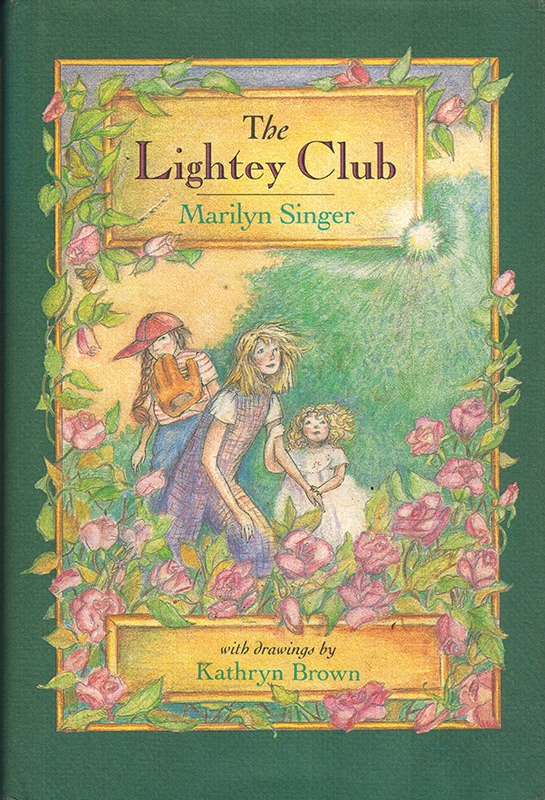
The Lightey Club

The Lightey Club

Three sisters, forced to spend the summer with their grandparents whom they don’t like, decide to form the Lightey Club. At each meeting, Henny, the oldest sister, recounts a new tale about Lightey the Lightning Bug and his insect pals. Henny’s stories help change a bad vacation into a magical one.

Ghost Host

Chapter Eight

Plink  plink.  Plink, plink.  Flap.

“Uhhh…”

Plink plinkity plinkity.  Rat-a-tat-tat.  Flap flap.

“What the…” Bart sat up in bed, trying to focus his eyes in the dark room.  He turned toward the window.  The shade, buffeted by the wind, was flapping back and forth in rhythm with the rain hitting th window pane.  Don’t forget to close all the windows tonight if it rains as it’s expected to. Bart heard his mother’s voice in his head.  “Oh, great,” he grumbled aloud.  He slid out from under the covers and sat for a moment on the edge of the bed.  Jeez, what a night, he thought, remembering his friends filing out the door silently–well, not so silently, in Tony’s case–and himself sweeping up the shards of the lamp.  There wasn’t anything he could do about the ripped tutu.  He didn’t know how to sew.  He could’ve asked one of the girls to do it, he guessed, but at the time he’d just wanted all of them gone–even Lisa.  Why do they have to act so stupid, he thought.  You could’ve told Bob and Tony not to bring the beer, another voice whispered in his brain.  But that wouldn’t have been cool…

The shade flapped again.  He stood up with a groan and shut the window.  Then, opening his bedroom door, he went to check the other windows in the house.

He was down in the kitchen when he heard the bump.  He stood still and listened. There it was again.  A loud thumping.  It was coming from the rec room.  “Oh, jeez.  Now what?” he said.  He opened the basement door and flicked the light switch.  But the light didn’t go on.  He tried it again and a third time.  Then his mother’s voice echoed in his head once more:  The switch in the basement seems to be faulty. He signed and went back to the kitchen and fished a flashlight out of a drawer.  He turned it on as he reached the basement door and started down the stairs.

Boorump.  The sound came again.

A wave of cold hit him.  The hairs on his neck prickled.  He stopped dead, clutching the stair railing with one hand.  The logic that had asserted itself the week before in his bedroom was failing.  He shuddered.

King Bart.  Bark the Hawk.  Ha, he told himself.  You’re real brave, Hawkins. Wouldn’t the Phantoms love to see their star quarterback now.  He stood still another moment.  Then, setting his chin, he edged down another step.  It’s probably just the boiler acting up, he thought.  No, it’s not on.  The water heater then.  Another step.  There’s got to be a logical explanation.  Another step. There, I made it.  He turned right into the room that housed the boiler and heater.  He inspected them with the flashlight, but nothing seemed wrong.  He walked out and on toward the rec room.

It was dark and quiet.  He played his flashlight over the furniture, the bar, the stereo, the TV, the knickknack shelves.  Nothing was wrong here either.  Then he noticed a box in a corner lying on its side.  A bit of frothy pink tulle spilled from it.  It rustled gently.  The tutus.  Bart had put the box on a low table when he’d cleaned up.

It must’ve fallen off, he told himself.  See, a logical explanation.  And you let yourself get scared of…

Boo-rump! The noise was so loud the walls shook.  Bart’s flashlight flew from his hand and across the room.  It way in the middle of the floor, its feeble light aimed at the tutu box.

Bart didn’t know whether to pick the flashlight up or leave it and run.  After a few seconds, which seemed like hours, he moved toward the light and froze.

The tutu  was sliding slowly out of the box.  “Tony,” Bart squeaked.  “Is that you?  Bob?  Is this a joke?”

The only answer was a rustle of satin and tulle as the tutu began to rise, headless, armless, legless, and advance toward him.

He screamed and staggered backward, banging his leg on a chair.  Then he whirled around, stumbling toward the stairs.

He fled up them, through the kitchen, up another flight, and down the hall.  He flew into his bedroom, slammed and locked the door behind him, turned on one, two, all the lights, and shaking, crawled into bed, face to the wall.  I’m going crazy, he thought, panting.  Then, no, I’m dreaming.  That’s it.  I’m still asleep and I…

Squeak.

Cold enveloped the room.  Oh my God, what was that?

Squeeeeak…

Bart’s blankets were sheets of ice.  He didn’t want to turn around, but he had to.  He did it slowly, his eyes darting wildly around the room.  Finally, they hit on the closet door.  It was open about an inch.  As he stared, it slid open an inch further.

No.  Oh no!  Wake up, Bart.  Come on, wake up.  He slapped at his face.

But the door continued to move.  Soon it was open enough for him to see his dirty football uniform lying on the floor with the helmet on the shelf above.  He watched in horror as the uniform began to straighten itself out and come toward him.

“No!” he yelled.  “No!”  He scrambled as far back against the headboard of the bed as he could.  But the uniform kept coming.

Click! Now what, he thought, and almost laughed hysterically at himself.  His eyes flashed on his bedroom door.

Sure enough, it was opening.  He saw a blaze of hot pink, and behind it streaks of electric blue, red, purple, and green.  The tutus!  They’d found him.

“Mom!  Dad!  Somebody help me!’ he bellowed as the tutus and the uniform reached him.  The lights went out.  His arms and legs flailed.  Perfume and sweat clogged his nostrils.  He was being smothered by yards and yards of cloth.  He gasped for breath.

Suddenly, a voice rang out.  “Oh, for goodness’ sake, Stryker, leave him alone.”

Bart gasped again, but he felt the tutus, the uniform slide away.  Panting and shivering, he lay with his eyes shut.  The room was silent now, but still cold.  Slowly he opened his eyes.

The lights were still out.  The room was dark, except for a faint glow at the foot of his bed.  it’s not over, something in his brain whispered.  Not yet.

He was right.  The flow brightened, pulsing silver.  It gathered, a roiling, shifting shape.

Terrified, Bart moaned.  He couldn’t move–he could only watch–as the glow trembled, wiggled, rounded.  A form began to emerge–the form of a tall, slim, and rather pretty teenage girl in a long, old-fashioned dress with a ribbon in her hair.  She smiled at him apologetically and said in a silvery voice, “I’m sorry about all this, Bart.  Truly sorry.”

He stared at her, blinked, and stared again.  And then he thought, Well, Hawkins, it looks like 1351 Hexum is haunted after all.

Mitzi Meyer, Fearless Warrior Queen

(excerpt from Chapter One)

Finally she came to a painting in the far corner of the room.  It wasn’t a particularly large painting or an especially bright one.  In fact it was rather dim and stormy.  It wasn’t painted by a famous artist, either.  But Mitzi didn’t care about any of that.

What she did care about was the figure in the painting.  It was a tall, strong woman with wild, dark hair that streamed out behind her.  She was riding in a chariot pulled by four horses.  Riding straight into battle.  Printed beneath the picture was her name: Boadicea–Queen of the Britons.

Mitzi had first discovered the painting on a class trip to the museum–one of the few class trips she’d thoroughly enjoyed.  The class was studying ancient Greece, so Mrs. Livetti and Mr. Morales, the art teacher, took them there to look at the collection of Greek vases.  Each vase had a different scene from Greek life or mythology on it.  All the students were to pick their favorite vase and write about what it showed.  Mitzi asked–and answered a lot of questions about the vases, the myths, and the history of Greece.  She chose a vase that showed a group of women dancing because she herself liked to dance.  Janet picked on in which were drinking wine, and everybody teased her about it, but she didn’t mind.

After they looked at the vases, the class got to tour the rest of the museum.   Mitzi had been there before, but she hadn’t really looked closely at many of the paintings.  When they got to the portrait gallery, Mitzi’s eyes wandered around the room until they landed on Boadicea.  Zap!  It was as if the queen’s own hand had reached out from the painting and pulled her over.  “Wow!” she said under her breath.

She stood, wide-eyed, staring at the fierce queen.  She was so captured by her that she nearly forgot she wasn’t alone in the gallery.

“Is that a relative of yours, Mitzi?” Diane Foster asked.

“Her mother, maybe?” said Bobbie Bolen.

“There is a slight family resemblance,” Tracey Dudeen added.

Mitzi didn’t say anything.  She didn’t want the Monkey Trio to know that she was thinking there actually was a resemblance.

“Let’s see what everyone’s staring at here,” Mr. Morales said, saving her from having to say anything at all.  “Why, it’s Boadicea, the Warrior Queen.  She nearly succeeded in freeing Britain from Roman rule.”

Mitzi listened closely to what Mr. Morales had to say about Boadicea’s exploits, but the Monkey Trio kept staring at her, so soon she sauntered away, trying to appear no long interested in the painting.  The truth was she was even more interested in it.  She went back to the museum the next day to look at it, and then a few days after that.

And here she was again.  Today was her fifth visit.  And she wasn’t tired of Boadicea at all.  She stared long and hard at the picture.  She could see the queen’s horses’ hooves pounding,  her chariot wheels turning.  On the spokes were knives, nasty, sharp knives to cut and slash the enemy to ribbons.  Clouds of dust blew up from under the wheels that turned faster and faster.  Boadicea’s whip cracked.

Suddenly, Mitzi felt the wind roaring all around her.  Her hair blew wildly about her head.  Instead of Boadicea, it was she who was in the chariot. the whip in one hand, the reins in the other.

“We will beat back the barbarians!” she shouted.  We will free the land!  We will never be Roman slaves!”

“Ha ha.”

“Ha ha?” Mitzi said.  She blinked.  Who was laughing?  It wasn’t Mitzi.  And it wasn’t Boadicea.  She blinked again.  She was no longer in the chariot.  She was sitting in front of a small painting on the cold, hard museum floor.  And standing next to her were two little kids pointing at her and giggling.

Lizzie Silver Of Sherwood Forest

Lizzie Silver of Sherwood Forest

(excerpt)

“Take that!  And that!  And that!” I said.  My sword rang out against the Sheriff of Nottingham’s.  He was a good swordsman.  Too good.  I couldn’t hold him off much longer.  Suddenly, with a quick parry, he knocked my sword out of my hands.  He laughed a nasty laugh.  “Breathe your last, Maid Lizzie,” he said, pressing the sharp point of his sword against my throat.

Suddenly a flash of Lincoln green.  “First you will reckon with me, sir,” said a low voice.

The Sheriff of Nottingham spun around.  He was face to face with Robin Hood.  “Here, Elizabeth, catch!” Robin called, tossing me my sword, just as three of the sheriff’s men found us.  “Back to back!” ordered Robin.

I smiled.  It was our favorite strategy.  “Take that!” I yelled, striking out.  One of the sheriff’s men fell.  Robin struck down another.  We were evenly matched again.

And then Robin stumbled.

Out of the corner of my eye, I saw the sheriff raise his sword to deliver a deadly blow.  I whirled around to fend it off…

“What are you doing in that weird position, Lizzie?  Studying some new form of yoga?” my sister, Rona, said.

I dropped my arms and sat down on my bed.  “How many times have I told you not to come into my room without knocking?”

Rona ignored my question.  “I bet you were pretending to be Robin Hood again.”

“I don’t pretend to be Robin Hood,” I said.  “Robin Hood is a man.”

“Robin Hood is a make-believe character, like Snow White or E.T.,” said Rona.

“That’s not true!” I yelled.

We’d had this argument before, Rona and me, and I always got angry at her during it.  I don’t know why I couldn’t just ignore her.  But I couldn’t.  I love Robin Hood too much.

I found out about Robin Hood from Buster.  Buster is my best friend Tessa’s uncle.  She doesn’t like him that much, but I do.  He used to dress up as famous Busters, like Buster Keaton and Buster Brown.  He said it was to “wake people up,” to surprise them.  He doesn’t do that anymore, though; he says a person shouldn’t always stick to the same thing to wake people up–and besides, he ran out of Busters.  Anyway, Buster gave me this book called Robin Hood of Sherwood Forest.  I don’t much like books, but I sure liked that one.  I read it so fast, Buster promised to get me another book with more stories about Robin Hood.  I can’t wait.

Mom says that Robin Hood is my latest obsession.  I asked her what an obsession is, and she said it means when you never stop thinking of something or someone.  She said Ariadne was my last obsession.  Ariadne is my pet tarantula.  I wanted a tarantula for a long time.  I guess I did think about her a lot.  And I did all sorts of things to get her.  it was Buster who helped me in the end.  But I didn’t think about Ariadne all the time.  I don’t think about Robin Hood all the time either.  I don’t think about him when I sleep (except if I have a dream about him) or when I watch Ariadne (except sometimes).