I Believe in Water: Twelve Brushes With Religion

I BELIEVE IN WATER: Twelve Brushes With Religion,

(Table of Contents)

THE BOY WHO CALLED GOD SHE

by Nancy Springer

Tough kid Mitch has got to laugh. Is that new kid at school kidding–God is no lady. Or is she?

CHATTERBOX

by Gregory Maguire

Mitch isn’t a chatterbox, that’s for sure. But maybe his words are getting through anyway–to the girls at Friendly’s, to Ma O’Shea, and, to God.

RELIGION: FROM THE GREEK RE LEGIOS, TO RE-LINK

by Virginia Euwer Wolff

Deborah, Zhandra, Riva–three girls with different beliefs, but one thing in common: they’re all pregnant.

FABULOUS SHOES

by Marilyn Singer

Can you lead on a boy and still be a good Jewish girl? Natalie needs to know.

ON EARTH

by Jacqueline Woodson

With her mother cast out of the Jehovah’s Witnesses, Carlene questions the very meaning of “paradise.”

GOING THROUGH THE MOTIONS

by Margaret Peterson Haddix

Jake has left a religious cult. Is Caitlyn still a member? Is she trying to draw Jake back in?

FORTY-NINE DAYS

by Kyoko Mori

After her father’s death, Shinobu struggles to harmonize the Zen and Christian religions of her parents and finds her own view of mercy.

THE MARTYRDOM OF MONICA MACALLISTER

by Jennifer Armstrong

Monica’s not Catholic, but she’s still sure she’d make a darn good saint.

HANDLING SNAKES

by Joyce Carol Thomas

It’s time for Letitia to follow her church’s ritual of handling snakes. How will she survive?

GRACE

by M.E. Kerr

Ted’s dad is the most boring minister in town. But when he gets rock star Taylor Train to appear at church, Ted learns the truth about glamor vs. integrity.

ESU’S ISLAND

by Jess Mowry

On Cayes Squellette, Pogo, Laurent, and Randy will soon become men–with the help of a playful and stern boy-god.

WHAT IS THE DICKENS?

by Naomi Shihab Nye

Christianity, Islam, Unitarianism, Sufism–Leslie’s background includes them all. But when Daddy Jack lies dying, what can she believe in but water.

On the Same Day in March

ON THE SAME DAY IN MARCH

(excerpts)

IN THE ARCTIC

Polar bears ride on floes of ice,
stalking seals,
wishing fish,
as the six-month sun begins to rise
slowly in the arctic skies.

On the same day in March…

***

in PARIS, FRANCE

The sun slips out, still winter pale.
But all over the city,
at bus stops and markets,
on small streets and grand boulevards,
people hurrying to work or school,
people, huddled in their coats and scarves,
sitting at outdoor cafes and sipping chocolat –
all of them turn up their faces
to enjoy the sun’s shy smile

On the same day in March…***

in NEW YORK CITY

It’s too gray to play outside today.
The parents sigh, the little kids complain.
But the basketball players stay in the schoolyard,
arguing what’s worse –
snow or sleet or freezing rain.

On the same day in March…***

in THE TEXAS PANHANDLE

They said it was just a tiny twister –
not big enough to spin a horse
or hoist a cow.
But it did suck up a bucket of water
and give Grandma’s dirty old truck
the first wash it’s had in weeks.

On the same day in March…

The One and Only Me

THE ONE AND ONLY ME

(excerpt)

When Dad and I walk down the street,

Mama says I’ve got his feet.

When Mom and I choose hats to wear,

Daddy says I’ve got her hair.

When I read books with Grandma Rose,

Grandpa says I’ve got her nose.

When Gramps and I pretend we’re spies,

Granny says I’ve got his eyes.

A Dog’s Gotta Do What A Dog’s Gotta Do

A DOG'S GOTTA DO WHAT A DOG'S GOTTA DO

(excerpt from Chapter Four)

A NOSE FOR TROUBLE

The thief was clever. He’d stolen the horse and buggy and left no clues. No clues that anyone could see. That made it a job for X-Ray and Jo-Jo. The two bloodhounds sniffed the horse’s currycomb, and then they were off! At first, their handler, Dr. J.B. Fulton, followed them in his own buggy. Then, as miles passed, he let the dogs ride with him. Whenever they reached a crossroad, Fulton sent the dogs out to steer them down the right path. For 135 miles across Kansas, they tracked that horse and the man who stole it – and found them. It was the longest scent trail any dogs had ever followed.

There’s a true story about a Border collie who was a terrific herder. She followed her master’s commands. She stared at her sheep and got them to move just the way her master wanted them to go. She was great at her job–and she was also blind. How did she know where the sheep were? She used her ears and, especially, her nose.

Like their wolf ancestors, dogs have good vision and great hearing. But it’s their sense of smell that is truly extraordinary. Some dogs can detect a single drop of blood in several gallons of water or a living person buried under many feet of snow. Dogs have always been able to hunt prey by scent. Many years ago, some dog breeders wondered if dogs could also use scent to track down animals and people who were lost. Could they trail criminals who didn’t want to be found? The answer was yes.

Of all breeds, bloodhounds are the champion trackers. Although they are hunting dogs, their name has nothing to do with killing. It’s from “blooded hound,” which means purebred. Bloodhounds are actually very gentle dogs. They would rather lick than bite the people they find. Bloodhounds can naturally recognize a person or animal by its scent, but they must be trained to track. First, the dog has to get used to its leash and then its harness. Then it learns to sniff an article of clothing or something else handled by a person. The dog finds that person by following his or her scent trail.

Every person leaves a scent trail. It is caused by millions of tiny skin cells that we shed every day. Each person’s scent trail is unique. We cannot smell this trail, but bloodhounds and other dogs can. The scent fades over time and with changing weather. But dogs can still smell it, even days later. They can detect the scent in the countryside, in a city, or even underwater. One criminal believed that if he sprinkled red pepper as he walked, it would disguise his scent. It didn’t. Another thought that if he drove a car, it would be impossible for a dog to follow his trail. It wasn’t. In a murder case on Long Island, New York, a bloodhound named Sappho tracked the murderer for three miles along the highway. The man’s scent had drifted out of his car onto the grass by the side of the road.

Bloodhounds were once the only breed whose evidence was allowed in court. The first bloodhound to testify was named Rye. Rye smelled a pillowcase that a murderer used to strangle his victims. Then the dog was brought to a group of suspects.He sniffed one man, sat before him, and barked. That man was the murderer. Now other breeds besides bloodhounds can testify in court, too.

Bloodhounds are also good at finding lost people and missing pets. But search and rescue is usually done by other breeds. Search and rescue means finding people trapped by earthquakes, avalanches, bombings, and other disasters. Some dogs will only look for living people. Others will search for dead bodies.

One of the most famous search-and-rescue dogs was a Saint Bernard named Barry. He was born in 1800, and he worked at the St. Bernard Hospice, a shelter for travelers in the Swiss Alps. The monks who lived there kept large mastiff-type dogs for many years. The dogs and the hospice were named for the human saint who founded the shelter. Barry’s job was to find and rescue people lost in the mountains. He had a smooth coat that kept the snow from sticking to his fur and weighing him down. He probably used his ears as well as his nose when he was searching. Scientists think that certain dogs, especially large ones such as St. Bernards and Newfoundlands, can hear as well as smell people buried deep under the snow.

There are many stories about Barry. Most of them say that he worked for twelve years and saved over forty people, and that one of those people was a little boy. In one version of this story, Barry and his handler, Brother Luigi, were out for a walk. An avalanche happened nearby. Brother Luigi wanted to return to the hospice. Barry disobeyed – something he’d never done before. He ran off alone. That night he returned with the boy. Before the boy’s mother died, she’d wrapped the child in her shawl and tied him to Barry’s collar. In another version, the boy was unconscious when Barry found him at the edge of an icy ravine no person could reach. The dog licked and pawed the boy awake, then dragged him to safety. No one is sure which story is true. But everyone believes that Barry must have been an extraordinary dog.

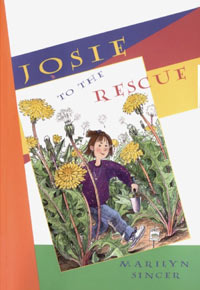
Josie to the Rescue

Josie to the Rescue

Chapter One

Mom had eaten all the cookies.

“Oh no, not again!” said Josie.

“I know, I know. I’m bad. But I can’t seem to stop eating these days.” She patted her large round belly.

“You should eat things that are better for you -like salad,” said Josie.

“I know, but I think this baby likes cookies,” Mom replied with a guilty look.

It made Josie laugh. She didn’t mind that Mom was having a baby. She already had one brother, Mickey. She liked being his older sister. It was an important job. She had to teach him a lot – the kind of stuff parents never remembered to teach. How to catch a firefly. How to jump off the back of the couch onto the cushions without getting hurt. How much milk to put on your cornflakes so they wouldn’t get too soggy too fast. She’d started keeping a list so she’d remember them all. It would take a while before the new baby was ready to learn those things, but Josie believed in being prepared.

“I’ve never seen a girl as organized as Josie,” her Aunt Linda liked to say. “Or as helpful. Except for my Mary Jane, of course.”

Mary Jane would smile and nod like she was wearing a princess crown on her shining blonde curls and didn’t want it to fall off.

Josie did not like being second to Mary Jane. She did not like the way her mother said, “Yes, Josie and Mary Jane are wonderfully helpful,” instead of saying, “Why, I think Josie is even more helpful than Mary Jane.”

“Mom, when do we start shopping for things for my new sister?” Josie asked now.

“He may be a brother,” Mom said.

“I don’t think so,” Josie replied matter-of-factly. “So, when do we go shopping? She’s going to need a lot of things – ”

“Don’t remind me,” Mom interrupted.

But Josie went on, “Clothes and toys and diapers and a new stroller – ”

“Maybe Dad can fix the old one.”

“Mom, that’s how it got broken in the first place!” Josie said.

“I know.” Mom sighed. It seemed to Josie she was sighing a lot these days.

Late that night, Josie found out why. She woke up thirsty and went to get a glass of water. Her parents were in their room, but the door was open a little, and Josie could hear them talking.

“I don’t know what we’re going to do. Everything’s so expensive these days… Food, clothes, diapers, bottles, toys, that darn stroller… How are we going to afford this baby?”

“Don’t worry, Alice. We’ll be all right. We always make do.”

“I know, Dan, but this time I’m not so sure.”

Whew. Josie chewed a piece of her hair. No wonder Mom was sighing so much.  Forgetting about her drink of water, she went back to her room and sat in what she called her “thinking chair.”  I’ll have to do something to help, she thought. Something wonderful. Something so fabulous Mom will stop sighing all the time. So terrific she’ll know I’m a thousand times more helpful than Mary Jane.

Josie smiled and curled up in her chair. Yes, that was a great plan! Now all she had to figure out was what that wonderful, fabulous, terrific thing would be.

Solomon Sneezes

(excerpt)

Solomon Snorkel has such a big sneeze,

he can blow all the leaves off

the sycamore trees.

He can empty the beehives of all of the bees.

That’s what Solomon’s sneezes can do.

***

Solomon Snorkel has such a large sneeze,

he can knock several skiers

right out of their skis.

He can break open locks,

so he doesn’t need keys.

That’s what Solomon’s sneezes can do.

Stay True: Short Stories for Strong Girls

STAY TRUE: Short Stories for Strong Girls

(Table of Contents)

TAKING TOLL

by Marion De Booy Wentzien

Miranda has gotten rid of all of Mom’s boyfriends, but Albert C. Cooksley is more of a challenge.

BUILDING BRIDGES

by Andrea Davis Pinkney

Bebe wants to spend the summer working on the Brooklyn Bridge, but Mama Lil thinks she should be helping out at a hairdresser’s instead.

GUESS WHO’S BACK IN TOWN, DEAR?

by M.E. Kerr

Tory and Horacio defy convention and family to find happiness.

GOING FISHING

by Norma Fox Mazer

Big-footed, big-voiced, big-herself Grace gets a glimpse of future independence.

THE TRANSFORMATIONS OF CINDY R.

by Anne Mazer

Cinderella, as you’ve never seen her before.

CRAZY AS A DAISY

by Rita Williams-Garcia

Marguerite’s a dancing fool–who’s no fool at all!

THE PALE MARE

by Marian Flandrick Bray

At the charreada corral, Consuela takes a stand for a horse–and for herself.

THE TRUTH IN THE CASE OF ELIZA MARY MULLER, BY HERSELF

by Peni Griffin

Eliza Mary confrontation with her abusive brother-in-law has tragic results.

THE STATUE OF LIBERTY FACTORY

by Jennifer Armstrong

Her parents reneged on a promised trip to Paris. Now Monica’s protesting!

STAY TRUE

by Drew Lamm

Growing up drives Molly-be-Gone and Stick-Person-Girl apart. Can they save their friendship?

THE MAGIC BOW

by Marilyn Singer

Can a princess find a husband who’s really her equal?

Prairie Dogs Kiss and Lobsters Wave: How Animals Say Hello

PRAIRIE DOGS KISS AND LOBSTERS WAVE: How Animals Say Hello

(excerpt)

INTRODUCTION

When people meet each other, they shake hands, slap five, smile, salute, bow, embrace, say, Yo.  Hello.  How are you?  Good morning.  Good evening.  What’s up?  What’s new? They may be happy to see each other.  They may not care very much at all.

Strangers greet each other differently than people who know each other well.  You wouldn’t greet a new kid at school the same way you’d greet your best friend.  You wouldn’t say hello to your mother the same way you’d say hello to the president of the United States.  Most greetings are friendly or polite. Some aren’t.  Some greetings show respect for a person’s rank.  Most probably don’t.

The same is true of animals.  Their greetings are as many and varied as the species themselves.  You know how people greet each other. But what are animal greetings like? When different animals meet their own kind, just what do they do?

***

DOGS SNIFF

Dogs have an amazing sense of smell – maybe forty times better than people’s.  So it’s no surprise that dogs use their noses to say hello.

When dogs, and other animals in the canine, or dog, family, such as wolves and coyotes, meet, they smell each other’s faces and hindquarters. Sniffing can tell each dog whether the other one is a male or a female, whether it’s a grown-up or a puppy, and whether it wants to mate or not.

If they’re friendly, dogs welcome each other with wagging tails, upright or forward ears, bows, and happy barks.  If they’re not, they greet each other with drooping or stiff tails, flattened ears, bared teeth, and growls.

Like most other canines, dogs are social animals and like to travel in packs.  Within a pack, whether it’s large or small, each dog has a rank.  Their body language when they greet tells which dog is dominant – has a higher rank – or if they’re equals.  A top dog will stand tall and straight and stare right at the other dog.  Sometimes it will put its head or neck on the other dog’s shoulder.  An underdog will bow its head, lower its body, and look away. It may even lie down on its side or back.  Equals don’t threaten or act defenseless.  Their greetings are brief and often lead to playing or to ignoring each other.  Even though most pet dogs don’t live in packs, when they meet other dogs, they act as if they do.

Dogs learn this body language when they’re pups. Soon they become good at learning who’s the boss and which other dogs to play with or stay away from.  If you learn dogs’ body language, you can figure out which dogs to play with or stay away from too.

Deal with a Ghost

DEAL WITH A GHOST

(excerpt from Chapter 6)

She walked around to the other side of the building, where 513, the music room, was.  The shades were drawn, but she could see a light behind them.  “All right!” she breathed, relieved.  Someone was still there.  One window was partly open.  It had been stuck that way for weeks.  Mr. Benson hadn’t gotten around to repairing it yet. Through it she could hear the piano, muffled and hesitant, as though someone was trying to pick out a melody.

Deal raised her hand to rap on the glass. But then she wavered.  The would-be piano player was weeping.  For a moment Deal weighed courtesy versus need.  Need won.  She knocked on the window.  The piano plunking and the crying grew louder. She knocked again, and they were louder still.  Concerned now, she tried to open the other windows.  They were all locked.  Cursing loudly, she jerked roughly at the one that was stuck, and suddenly it slid up as smoothly as if it had been oiled.

The piano was crashing and discordant now; the weeping had changed to wailing.  The sounds rattled Deal’s teeth, rippled icily over her skin. She hesitated again, then bravely hoisted herself up onto the sill, raised the shade and jumped into the room.  She got just a hazy glimpse of the figure at the piano – a slight figure all in white bathed in a misty glow – before it vanished, plunging the room into darkness.